
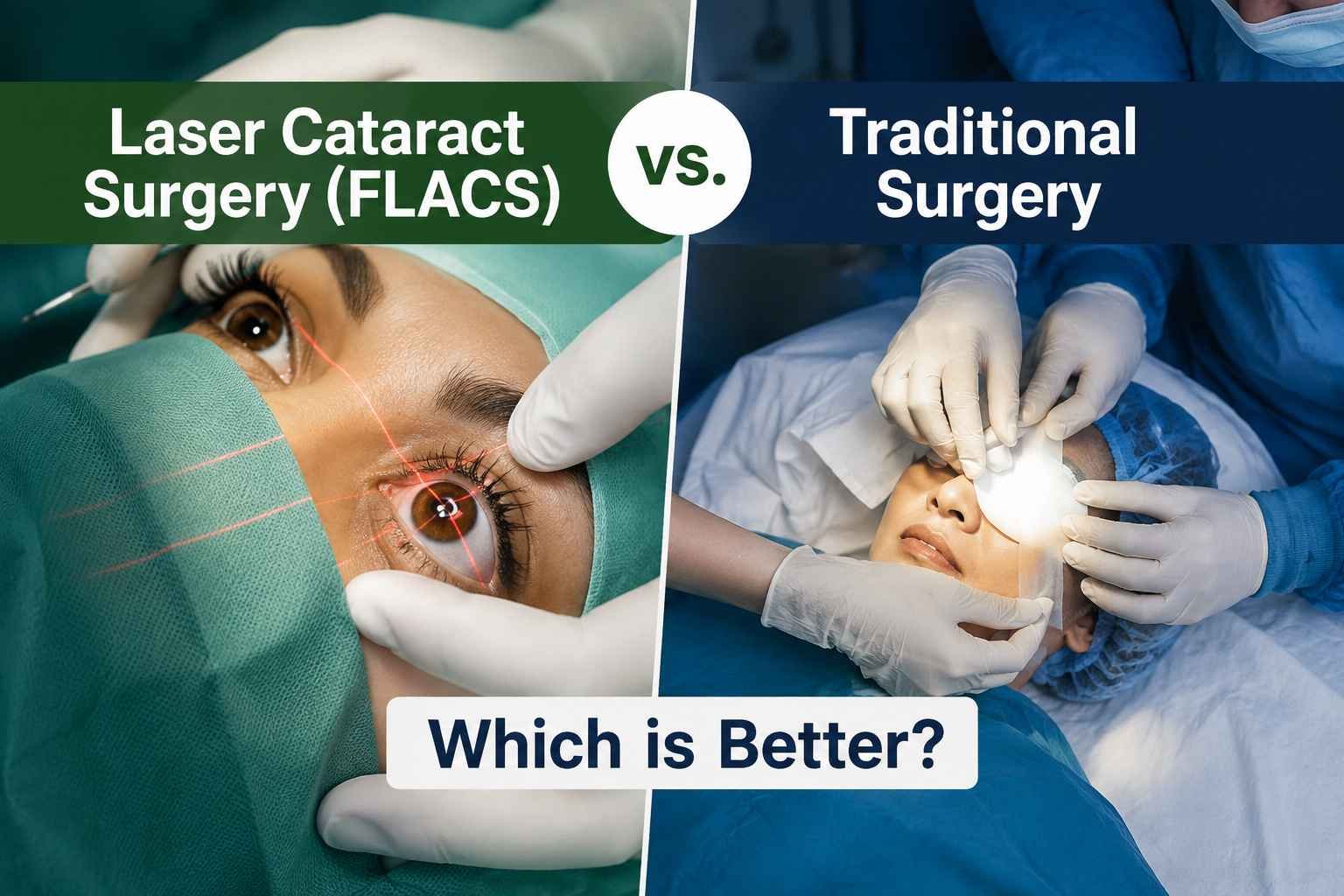
When clearer vision matters, precision can make every step count. Cataract surgery has changed significantly over the years, giving patients safer and more personalised options for restoring clear vision. Traditional cataract procedures remain highly established and effective, while newer technologies have introduced additional precision and automation into selected stages of the procedure.
One such advancement is laser cataract surgery, also known as Femtosecond Laser-Assisted Cataract Surgery or FLACS. It uses a specialised laser to perform certain steps that were traditionally completed manually. But does this technological upgrade automatically mean better results for every patient? Understanding the differences between the two approaches can help you have a more informed discussion with your eye specialist.
What Is Laser Cataract Surgery?
Laser cataract surgery uses a femtosecond laser to assist with specific stages of cataract removal. Depending on the technology and treatment plan, the laser can help create precise corneal incisions, make a circular opening in the lens capsule, and fragment the cataractous lens before it is removed.
The procedure still involves removing the cloudy natural lens and replacing it with an artificial intraocular lens. The laser does not perform the entire operation independently. An eye surgeon remains responsible for evaluating the patient, planning the procedure, managing the surgery, and selecting the appropriate lens.
The main attraction of FLACS is its ability to provide computer-guided precision during particular surgical steps.
What Is Traditional Cataract Surgery?
Traditional surgery generally refers to modern manual cataract surgery, most commonly performed using phacoemulsification. During the procedure, the surgeon makes a small incision, opens the lens capsule, breaks the cloudy lens into smaller pieces using ultrasound energy, removes the fragments, and implants an intraocular lens.
Although it may sound less technologically advanced than FLACS, traditional surgery is a highly refined procedure that has been successfully performed for many years.
For many patients, it provides excellent visual outcomes and remains the standard approach for cataract removal.
How Does the Precision of FLACS Compare?
The primary difference between FLACS and traditional surgery is how certain surgical steps are performed.
With laser-assisted procedures, the femtosecond laser can create specific incisions and lens fragmentation patterns based on preoperative measurements. This can offer a high degree of reproducibility for selected steps.
With traditional surgery, these steps are performed manually by the surgeon using specialised instruments and ultrasound technology. An experienced surgeon can make highly precise incisions and perform the procedure safely.
Therefore, the word “precision” should not be interpreted as meaning that traditional cataract surgery is inaccurate. Both approaches can provide excellent results when appropriately planned and performed.
Is Laser Cataract Surgery Better for Everyone?
Not necessarily. The suitability of laser cataract surgery depends on several factors, including the patient’s eye health, cataract characteristics, corneal condition, astigmatism, overall medical history, and the surgeon’s assessment.
Technology can provide useful advantages, but it does not eliminate the importance of surgical expertise or patient selection.
A top eye specialist in Vadodara can evaluate your eyes and explain whether FLACS offers a meaningful advantage in your specific situation.
What Are the Potential Benefits of FLACS?
One potential advantage of FLACS is the ability to automate certain surgical steps with computer-guided laser technology. This can allow highly precise corneal incisions and lens fragmentation.
For selected patients, the technology may also be useful when planning treatment for certain types of astigmatism or when a surgeon wants greater control over specific aspects of the procedure.
However, the benefits need to be considered alongside the additional technology and associated costs. The most advanced option is not necessarily the most appropriate choice for every patient.
What Are the Strengths of Traditional Surgery?
Traditional surgery has several important advantages. It is well established, widely available, and supported by extensive clinical experience. Modern phacoemulsification uses very small incisions and sophisticated instruments, allowing surgeons to remove cataracts efficiently.
Another advantage is that surgeons can adapt the technique during the procedure based on what they observe. Their experience and judgement remain central to achieving a successful outcome.
For many patients, traditional surgery can provide excellent visual results without requiring the additional cost of a femtosecond laser.
Does FLACS Mean Faster Recovery?
It is tempting to assume that a more technologically advanced procedure automatically results in a faster recovery. However, recovery after cataract surgery depends on several factors.
These can include the patient’s general eye health, the severity of the cataract, the surgical technique, the type of intraocular lens used, and whether complications or underlying eye conditions are present.
Both FLACS and traditional surgery are designed to use small incisions and can allow patients to resume many everyday activities relatively quickly when recovery progresses normally.
Your surgeon can provide more specific guidance based on your individual procedure.
What About Vision Quality After Surgery?
The ultimate goal of cataract surgery is to improve functional vision by removing the cloudy natural lens and replacing it with an artificial lens.
Visual outcomes can be excellent with both approaches. The choice of intraocular lens can also have a significant influence on the type of vision a patient experiences after surgery.
For example, some patients may be suitable for monofocal, toric, multifocal, or extended-depth-of-focus lenses, depending on their eye health and visual needs.
A modern eye center in Vadodara can assess your eyes and discuss which lens options may be appropriate for your lifestyle.
Driving at Night After Cataract Surgery
Driving at night after cataract surgery can become more comfortable once the cataract-related cloudiness, glare, and reduced contrast have been addressed. However, the quality of night vision depends on more than the surgical technique alone.
Factors such as the type of intraocular lens, residual refractive error, dry eye, corneal health, and other eye conditions can influence glare, halos, and contrast sensitivity.
Patients should wait until their vision has stabilised and their eye specialist confirms that they are safe to drive before returning to night-time driving.
Does FLACS Reduce the Need for Surgeon Expertise?
No. Even though the laser performs certain automated steps, the procedure still depends heavily on professional judgement.
The surgeon must assess the patient’s suitability, plan the treatment, select the appropriate intraocular lens, manage the surgical process, and monitor recovery.
This is why choosing a top eye specialist in Vadodara can be more important than simply choosing between two technologies.
The best outcome comes from combining appropriate technology with careful diagnosis, surgical experience, and personalised treatment planning.
Choosing a Modern Eye Center in Vadodara
If you are considering cataract surgery, selecting a modern eye center in Vadodara can give you access to advanced diagnostic equipment and different treatment options.
A comprehensive evaluation can help determine the severity of the cataract, assess the cornea and retina, measure the eye accurately, and identify any other conditions that could influence the outcome.
Rather than asking whether FLACS is universally better than traditional surgery, it is more useful to ask which approach is appropriate for your eyes.
Is the Precision Upgrade Worth the Cost?
For some patients, the additional precision and technology offered by FLACS may be worth considering. For others, traditional surgery may provide an excellent outcome without the additional expense.
The answer depends on individual circumstances. Factors such as astigmatism, cataract characteristics, corneal health, lens selection, expectations, and budget can all influence the decision.
Discussing these factors with a top eye specialist in Vadodara can help you understand what you are paying for and whether the additional technology is likely to provide a meaningful benefit.
Making the Right Cataract Surgery Decision
Cataract surgery should never be viewed as a simple choice between an older and newer procedure. Both FLACS and traditional surgery have important roles in modern cataract care.
The most suitable approach depends on your eye health and surgical requirements. A detailed examination allows your surgeon to determine whether laser assistance would add meaningful value or whether conventional phacoemulsification is the better choice.
A modern eye center in Vadodara can provide the diagnostic evaluation needed to make this decision based on your individual needs rather than marketing claims.
Conclusion
Laser cataract surgery offers computer-guided precision during selected stages of cataract treatment and can be a valuable option for appropriately selected patients. At the same time, traditional surgery remains a highly established and effective approach that can deliver excellent outcomes when performed by an experienced surgeon.
The decision should not simply come down to choosing the newest technology. Your eye health, cataract characteristics, lens requirements, lifestyle, and individual expectations all matter.
At Desai Eye Hospitals, patients can receive detailed evaluations and personalized cataract care using modern diagnostic and surgical approaches. If you are considering cataract surgery and want to understand which procedure is right for you, contact us today to schedule a consultation with our eye care team and explore the most suitable treatment option for your vision.