

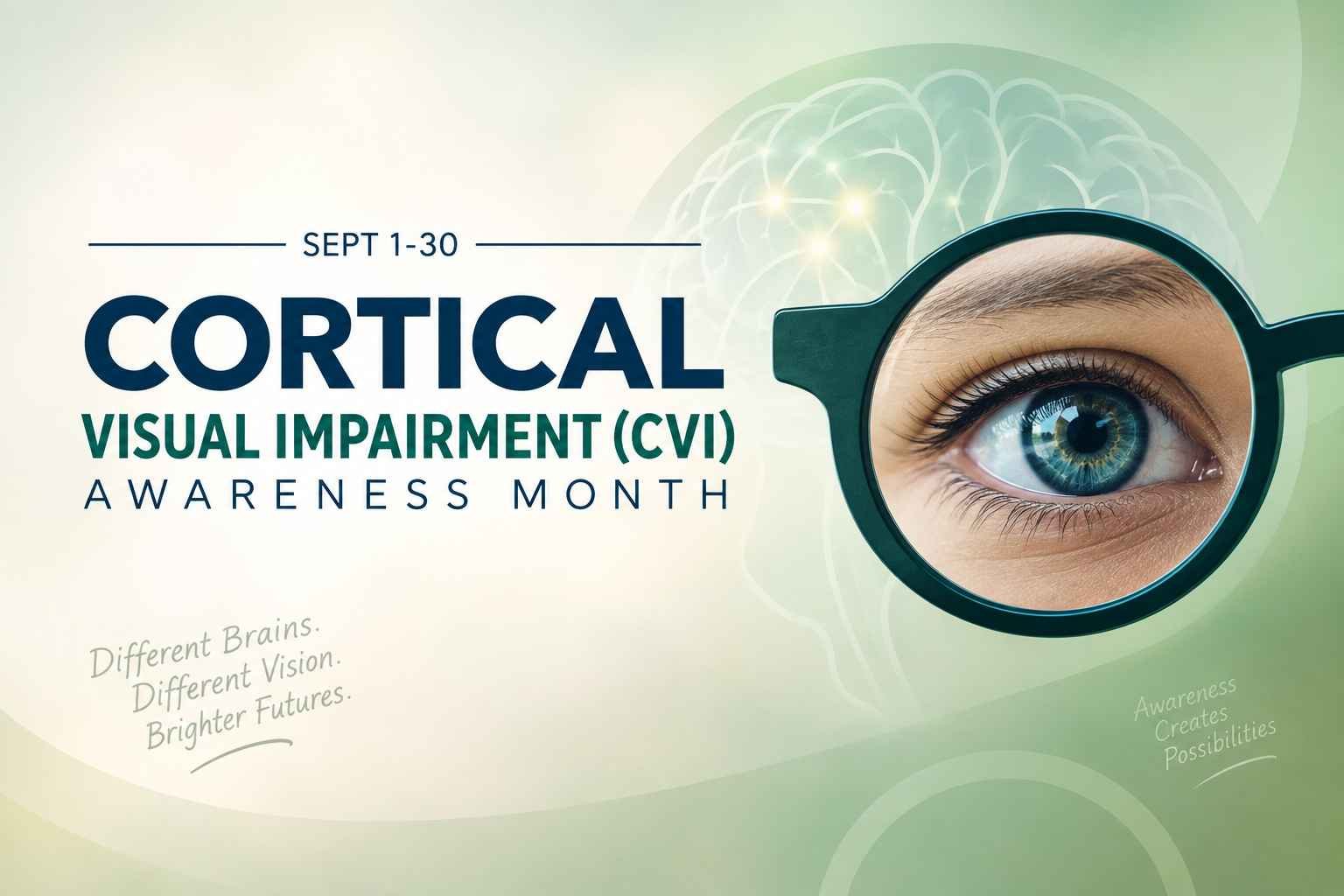
When the eyes see but the brain struggles to understand, recognising the signs can open the door to better support. During CVI Awareness Month, parents, teachers, and caregivers are encouraged to learn more about Cortical Visual Impairment, a condition in which the brain has difficulty interpreting visual information. A child may have healthy-looking eyes but still experience significant difficulties with seeing, recognising, or making sense of what is around them. Understanding the early warning signs can help parents seek appropriate professional assessment and support.
What Is Cortical Visual Impairment?
CVI Awareness Month helps bring attention to Cortical Visual Impairment, a neurological visual condition that affects how the brain processes visual information. It is different from many eye conditions because the primary difficulty is not necessarily with the eyes themselves. Instead, the brain’s visual pathways or areas involved in interpreting visual information may not process what the child sees normally.
CVI can affect children in different ways. Some may have difficulty recognising objects, faces, colours, or visual patterns, while others may struggle to navigate unfamiliar environments or locate an object among several others.
The severity and characteristics of CVI can vary considerably from one child to another. This is why individual assessment is important rather than assuming that every child will experience the condition in the same way.
Sign 1: Difficulty Recognising Familiar Objects
One possible early sign is difficulty recognising familiar objects. A child may appear to see an object but may not immediately understand what it is or may struggle to identify it when its position changes.
For example, a child might recognise a favourite toy when it is placed against a simple background but have difficulty locating the same toy among several other objects.
During CVI Awareness Month, parents can pay attention to these patterns rather than assuming that the child is simply distracted or uninterested.
Sign 2: Difficulty Finding Objects in Busy Environments
Visual clutter can be challenging for children with CVI. A child may have difficulty finding a particular toy in a crowded room, locating an item in a school bag, or identifying something on a busy table.
They may respond more effectively when the number of objects around them is reduced or when the target object is presented against a simpler background.
If these difficulties occur regularly, an eye specialist in Vadodara can assess the child’s vision and help determine whether an underlying visual concern requires further evaluation.
Sign 3: Unusual Ways of Looking at Objects
Children with CVI may sometimes use unusual visual behaviours when attempting to understand an object. They might look from the side, turn their head, look away while reaching, or need additional time before responding to something visually presented.
These behaviours can be easy to overlook because they may not occur consistently.
CVI Awareness Month provides an opportunity for parents to become more observant of how their child uses vision during everyday activities. Noticing repeated patterns can be useful when discussing concerns with an eye care professional.
Sign 4: Difficulty Recognising Faces
Some children with Cortical Visual Impairment may have difficulty recognising familiar faces. A child may recognise a parent or teacher more easily through their voice, clothing, hairstyle, or movement than through their facial appearance.
This can become more noticeable in crowded environments or when several familiar people are present.
Parents who notice persistent difficulty recognising people visually can consult an eye specialist in Vadodara to discuss the child’s overall visual function and determine whether further assessment may be appropriate.
Sign 5: Difficulty Tracking or Maintaining Visual Attention
Another possible warning sign is difficulty following a moving object or maintaining visual attention on something for an expected period. A child may appear to lose interest quickly or may require additional time to visually locate something.
However, these behaviours do not automatically mean that a child has CVI. Similar difficulties can occur with other visual, developmental, neurological, or attentional concerns.
As part of CVI Awareness Month, parents can observe whether these behaviours become more noticeable under particular conditions, such as poor lighting, busy surroundings, or when several visual objects are presented at once.
Sign 6: Challenges With Everyday Visual Tasks
Cortical Visual Impairment can affect everyday activities in ways that may initially be misunderstood. A child may struggle to copy information from a board, recognise pictures, navigate unfamiliar spaces, find belongings, or interpret visual symbols.
These challenges may sometimes be mistaken for poor concentration, learning difficulties, or reluctance to participate.
An annual eye checkup in Vadodara can help monitor a child’s eye health and provide an opportunity for parents to discuss unusual visual behaviours. Depending on the findings, additional assessments may be recommended to understand how the child’s visual system is functioning.
CVI Awareness Month and Learning Strategies for Children
Learning strategies for children with Cortical Visual Impairment should be based on their individual visual abilities and needs. Some children may benefit from reducing visual clutter, presenting one item at a time, allowing additional processing time, or using clear and consistent cues.
Teachers and caregivers can also observe which environments make visual tasks easier or more difficult. For some children, a simpler background may make an object easier to identify, while others may respond better when visual information is combined with verbal or tactile cues.
The aim is to understand how the individual child processes visual information rather than assuming that one approach will work for everyone.
Why Regular Eye Assessments Still Matter
Although CVI involves how the brain processes visual information, children can also have eye conditions alongside neurological visual impairment. Regular eye assessments therefore remain an important part of maintaining overall eye health.
An annual eye checkup in Vadodara gives parents an opportunity to monitor vision and discuss any changes or concerns. An eye care professional can assess the eyes and determine whether additional investigations or referrals may be appropriate.
During CVI Awareness Month, parents should remember that noticing one or more warning signs does not necessarily mean that a child has Cortical Visual Impairment. Professional evaluation is needed to understand the cause of any persistent visual difficulties.
How Parents Can Support a Child With CVI
Parents can begin by observing how their child responds to different visual situations. Notice whether the child performs differently depending on lighting, distance, background clutter, movement, colour, or the number of objects present.
Keeping a record of these observations can provide useful information during an appointment. Parents can also communicate with teachers, therapists, and other caregivers to understand whether similar behaviours occur at school or in other environments.
Providing patience and allowing a child sufficient time to process visual information can also create a more supportive environment.
When Should Parents Seek Professional Advice?
Parents should consider professional advice when a child consistently struggles with recognising objects, identifying people, navigating spaces, following visual information, or performing everyday tasks that rely on vision.
An eye specialist in Vadodara can evaluate the child’s eyes and discuss whether further assessment is needed. A detailed understanding of the child’s visual behaviour can help healthcare professionals distinguish between different possible causes.
Early attention to persistent concerns can also help parents and caregivers understand how best to support the child’s visual development and daily activities.
Supporting Better Awareness of Cortical Visual Impairment
CVI Awareness Month reminds families that vision involves more than the eyes. The brain must receive, process, and interpret visual information for a child to make sense of what they see. When a child’s visual responses appear unusual or inconsistent, those behaviours deserve thoughtful attention.
An annual eye checkup in Vadodara can form part of a child’s regular eye health routine, while appropriate professional assessment can help identify concerns that may require further investigation or support.
At Desai Eye Hospitals, we believe that understanding children’s visual needs is an important part of supporting their overall development and well-being. Our team is committed to providing professional eye care and guidance tailored to each patient’s individual needs.
If you have noticed unusual visual behaviour or have concerns about your child’s vision, contact Desai Eye Hospitals today to schedule a consultation and discuss the appropriate next steps with our eye care specialists.